
Your challenge with (PUR) hotmelt lamination
By now, you’ll be aware that hotmelt can offer significant advantages: higher initial tack, higher line speeds, a stronger bond, less downtime in the process and a higher output per square metre of production space. However, in practice, a successful switch to hotmelt lamination remains quite a challenge.
Every combination of materials reacts differently. Surface tension, moisture content, temperature, adhesive application rate, production speed and press pressure all influence the end result. What works well on paper does not always deliver the desired adhesion, product quality or capacity in practice.
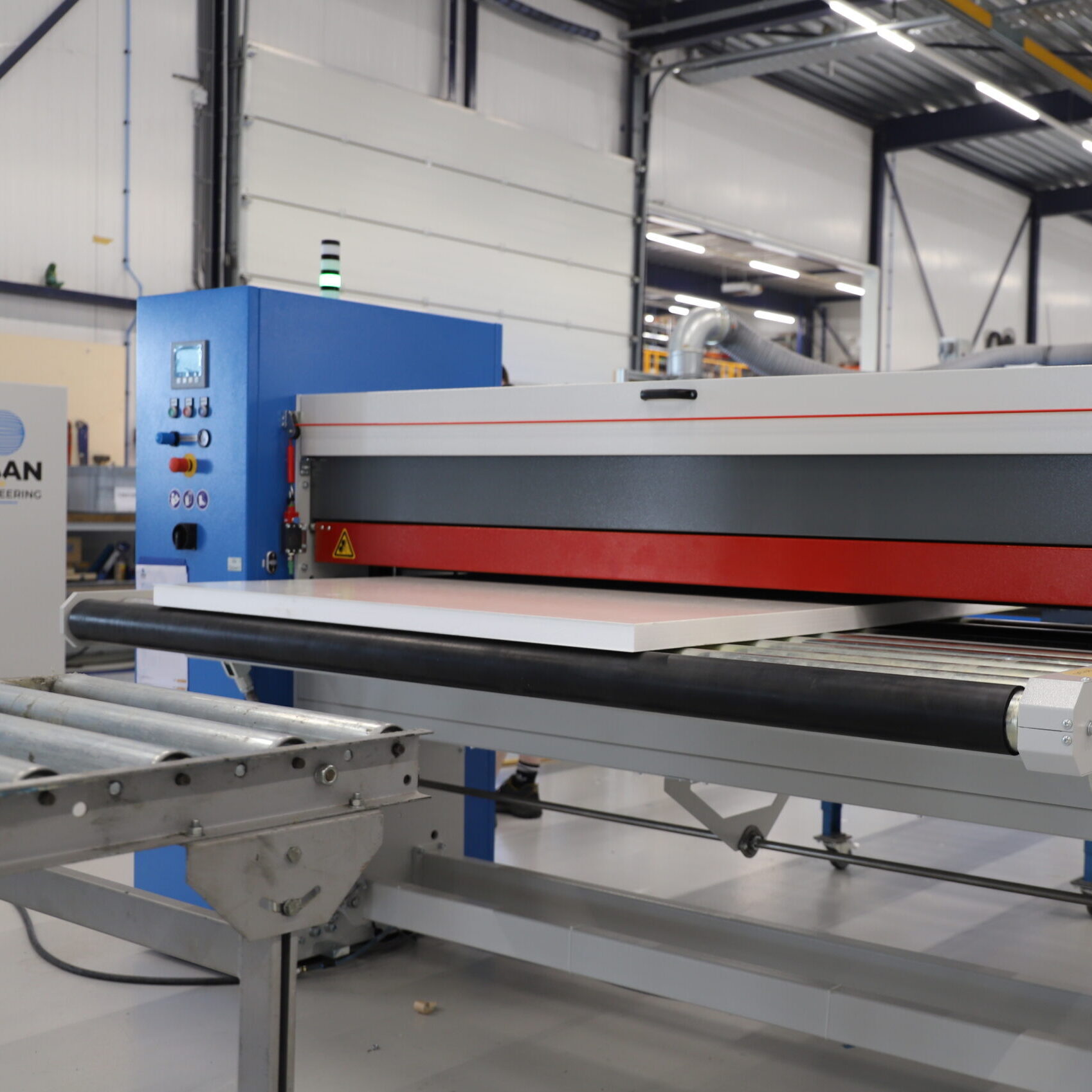
That is why successful hotmelt lamination is not just about having the right equipment. It is about having complete control over the process – from material pre-treatment and adhesive application to lamination, pressing and curing.
We understand these challenges and are happy to help you get your hotmelt production process running perfectly.
Challenges in hotmelt lamination
Finding the right combination between material and adhesive
Not every material can be bonded in the same way. MDF, HDF, plywood, HPL, aluminium, steel, foam materials and composites all have their own properties. Some materials are highly absorbent, whilst others have low surface tension. As a result, a material that can be processed without any problems on one production line may unexpectedly cause quality issues on another. Finding the right combination of material, adhesive type and process settings is therefore often one of the greatest challenges in hotmelt lamination.
Maintaining a stable coating profile
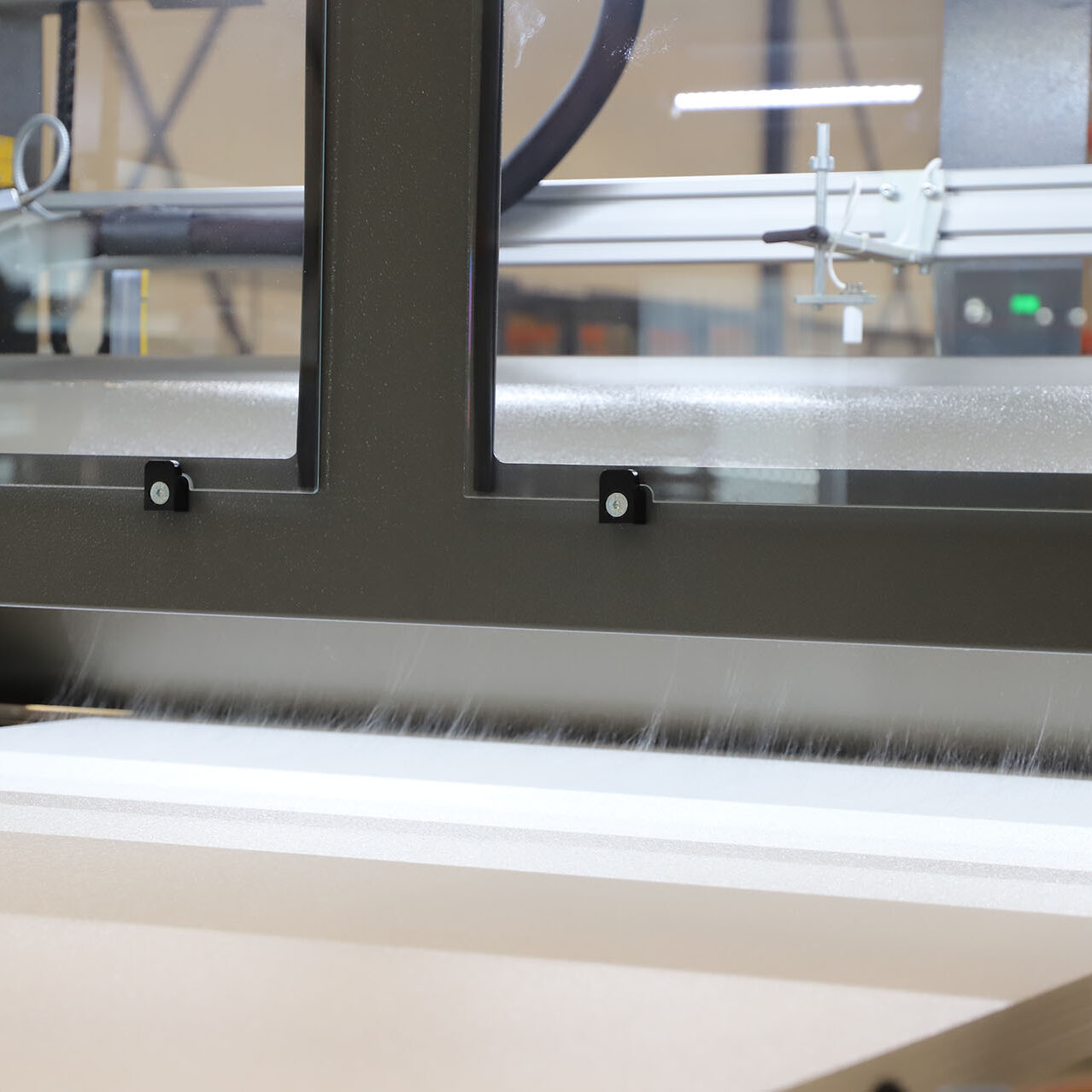
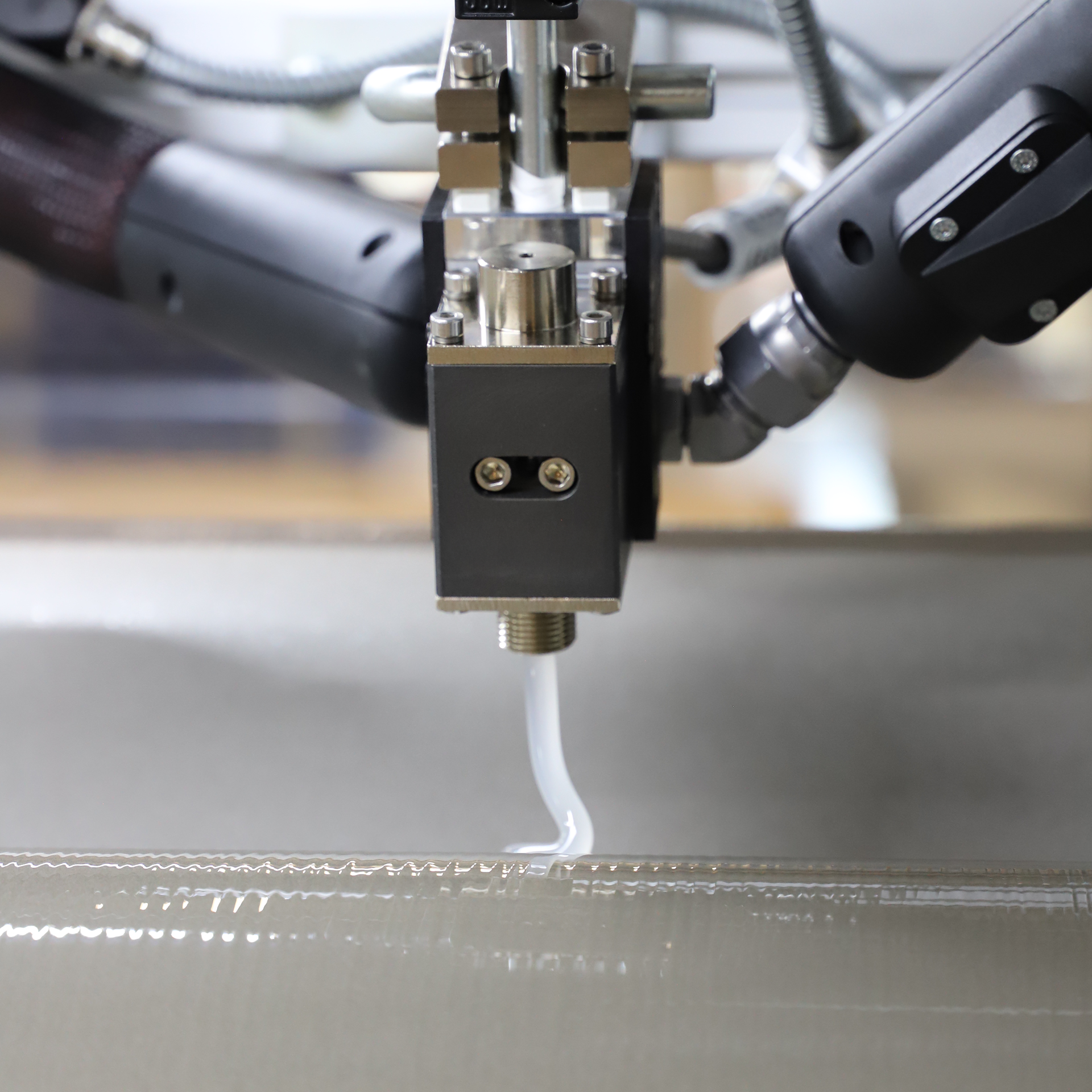
A strong bond depends entirely on an even distribution of adhesive. When coating weights fluctuate or the adhesive is not applied uniformly, variations in the bond occur. This can lead to quality issues, increased adhesive consumption and unnecessary rejects. Process stability becomes increasingly critical, particularly at higher production speeds, as the same operations must be carried out within a shorter cycle time. You want to be sure that your quality is guaranteed, even at higher speeds. We understand that.
Increasing output without compromising quality
Higher line speeds present new challenges. How do you ensure that the adhesive has enough time to wet the surface? How do you maintain a consistent application of adhesive? And how do you prevent quality from deteriorating as production capacity increases? The trick lies in finding the optimal balance between speed, quality and reliability.
Moving to Monomer Reduced adhesives
Monomer Reduced (MR) adhesives represent a new generation of adhesives that meet stricter safety and environmental requirements. Although the benefits of these adhesives are clear, this transition also raises new questions. How does an MR adhesive affect the process? Is its performance comparable to that of traditional hot-melt adhesives? And is your existing production line suitable for this? To make the most of the benefits of MR adhesives, the entire process chain must be right: from melting and conditioning to coating and lamination.
Why process control makes the difference
Many of the challenges in hot-melt lamination can be traced back to one key issue: process control.
An optimal end result is achieved when all critical parameters are properly coordinated:
- Correct conditioning of the PUR hot-melt
- A stable adhesive temperature
- A uniform coating pattern
- The correct coating weight
- Sufficient surface tension of the material
- Precise positioning of the panels
- The correct pressing pressure during lamination
- A controlled curing process
- Optimal processing of both conventional and MR adhesives
When these factors come together, the result is a process that is not only reliable but also scalable. And that forms the basis for a sound business case.
Building a viable business case
Ultimately, every investment is about return on investment. The question is not just whether the hot-melt adhesive works from a technical point of view, but above all how much cheaper, faster or more efficient your production process will become. Would you like to gain a better understanding of your output forecasts, production costs, handling, adhesive consumption and quality?
Answering that question requires practical experience, process knowledge and a realistic analysis of your specific situation.
How we support you
We understand that every lamination application is unique. That is why we look not only at the machine, but at the entire process. We support you, the manufacturer, from the initial material analysis right through to the production run. Together, we achieve a stable, efficient and future-proof hotmelt process.
Our expertise focuses on:
- Hotmelt coating and lamination
- Material testing and adhesion issues
- Surface treatment
- Process optimisation
- Capacity increase
- Business case calculations
- Fully automated production lines
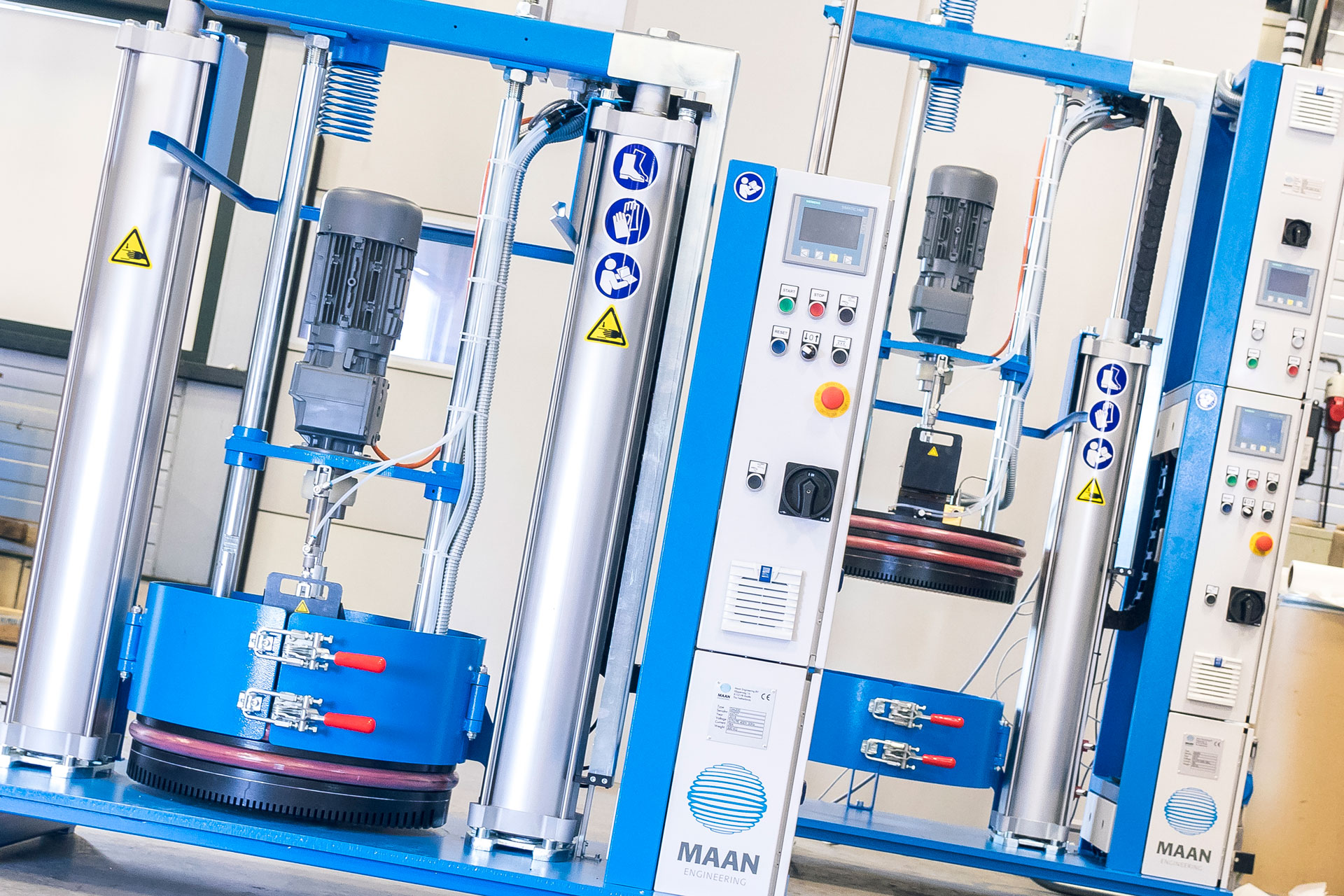
In our test centre, we work together towards the best possible result. In this way, we gain experience, build up process knowledge and provide insight in advance into the feasibility and return on investment of the project.
After all, a successful hotmelt line is not created simply by choosing the right machine. It is created by bringing together the right materials, knowledge, experience and technology.

Tell us about your coating aspirations
We'll make it happen!