
Why PUR hotmelt lamination?
Maan Engineering equipment processes different hotmelt technologies accurately, from thermoplastic adhesives to reactive systems such as PUR. The right choice depends on your product requirements. PUR hotmelt is often selected for its combination of productivity, strong adhesion and performance under demanding conditions.
Make a difference with PUR hotmelt
Want to increase output without adding people, equipment or production space? PUR hotmelt lamination can make a decisive difference. Rapid initial tack, short processing times and high final bond strength can increase line capacity, improve product quality and reduce cost per panel. Modern Monomer Reduced adhesives can also support stricter safety and environmental requirements without compromising performance or productivity.
The key benefits of PUR hotmelt lamination
One of the biggest advantages of PUR hot-melt is its extremely fast initial bond. As soon as the adhesive has been applied and the materials brought together, a bond strong enough to allow further processing of the product is formed immediately.
Whereas cold adhesives often require drying or pressing times, panels bonded with PUR hot-melt can move on to the next production stage almost immediately. This significantly reduces the lead time of your production process.
As the adhesive joints do not need to cure or be subjected to lengthy pressing processes, your line’s capacity increases immediately.
This allows you to produce more panels without having to purchase new machinery or take on extra staff. Thanks to the higher line speeds, you can utilise your existing production facilities more efficiently!
PUR hotmelt combines adhesion through cooling with chemical cross-linking. Once the adhesive has cooled, it reacts with moisture from the material and the ambient air, creating a permanent bond. The result is a bond that can withstand long-term stress and challenging conditions.
Many end products are exposed to fluctuating temperatures, damp conditions or intensive use. Thanks to chemical cross-linking, PUR hot-melt retains its stability, even under challenging conditions where other adhesive systems fail. This ensures that the bond remains reliable throughout the product’s entire service life.
PUR hotmelt adhesive can be used on a wide range of materials, including:
- MDF and HDF
- Plywood
- Chipboard
- HPL
- PIR, EPS, XPS and PU foams
- Aluminium
- Steel
- Stainless steel
- Glass and Plexiglas
As a result, PUR hotmelt adhesive is a versatile solution for a range of bonding challenges.
What does PUR hotmelt mean for your business case?
Lower production cost per panel
Higher line speeds and a more efficient production process enable you to produce more square metres per hour. This reduces the production costs per panel.
Reduced floor-space requirements
As long drying times and large buffer zones are no longer necessary, the production space required is reduced.
This means:
- Less interim storage
- Less internal transport
- Less product handling

Less manual handling
Automating the coating and laminating process reduces the number of manual process steps.
This not only increases productivity but also reduces the likelihood of errors.
Better and more consistent quality
A controlled coating process ensures consistent adhesive distribution and reproducible results.
This results in:
- Fewer rejects
- Fewer complaints
- Less rework
- Higher customer satisfaction
In this way, PUR hotmelt not only ensures better bonding, but also strengthens the overall business case behind your production process.
For which applications is PUR hotmelt lamination suitable?
PUR hotmelt lamination is used worldwide for the production of high-quality panels and composite products.
Common applications include:
Bonding PIR, EPS and XPS cores to metal or other facing materials.
Sandwich panels for façade, wall and roof structures.
Panels for furniture, walls, doors and interior finishes.
Bonding of foams and acoustic materials for sound insulation.
Lightweight panels with high structural strength.
Technical panels that must be able to withstand heavy use, moisture and temperature fluctuations.
Do you work with flat materials that need to be bonded quickly, accurately and reliably? If so, there’s a good chance that PUR hotmelt is a technology worth considering for your process.
Which equipment do you need?
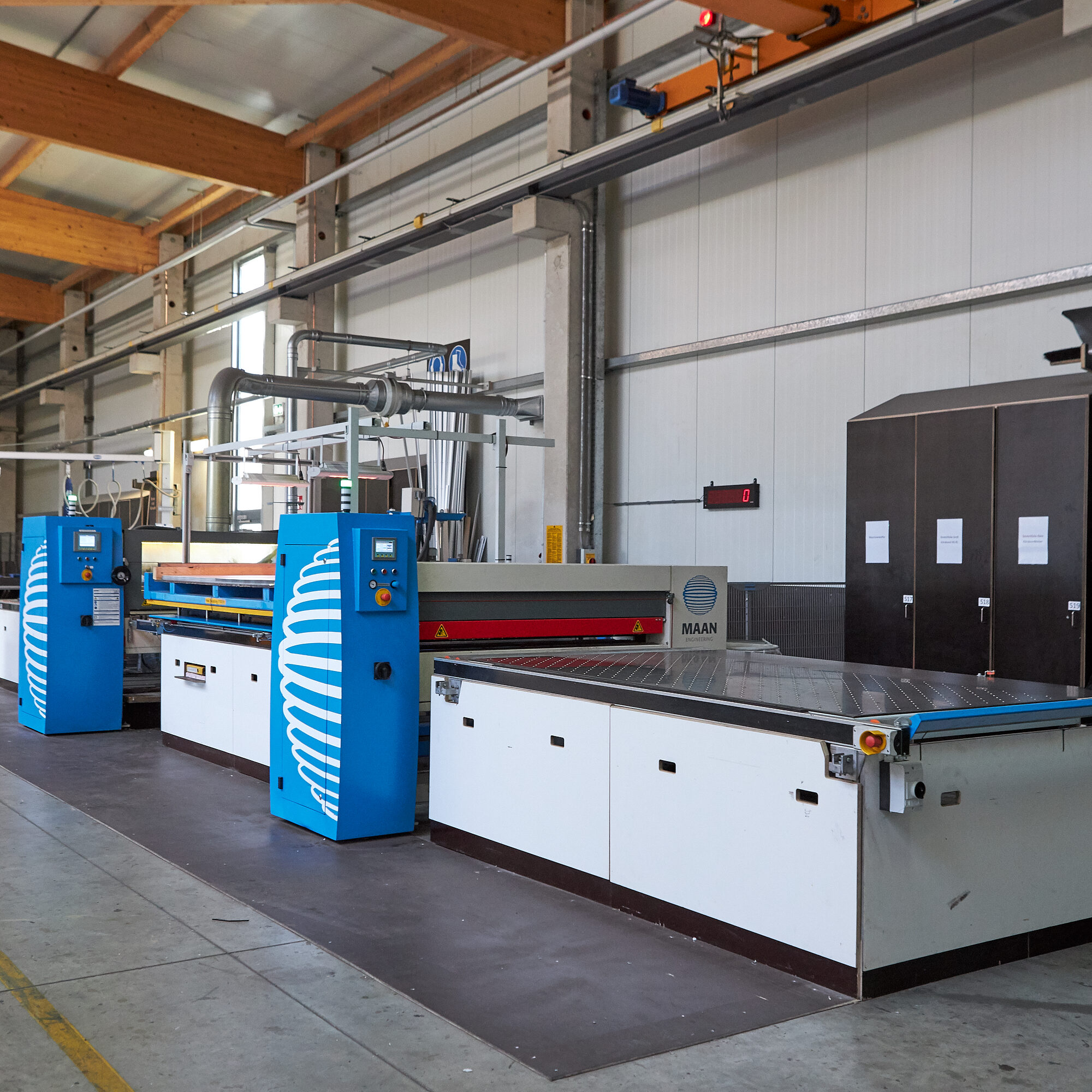
A reliable PUR hotmelt process starts with the right configuration. Depending on your application, a complete line usually consists of the following components:
Together, these components form a stable, reliable and scalable production process that enables you to achieve consistent quality.

Calculate your business case
And we'll make it happen!